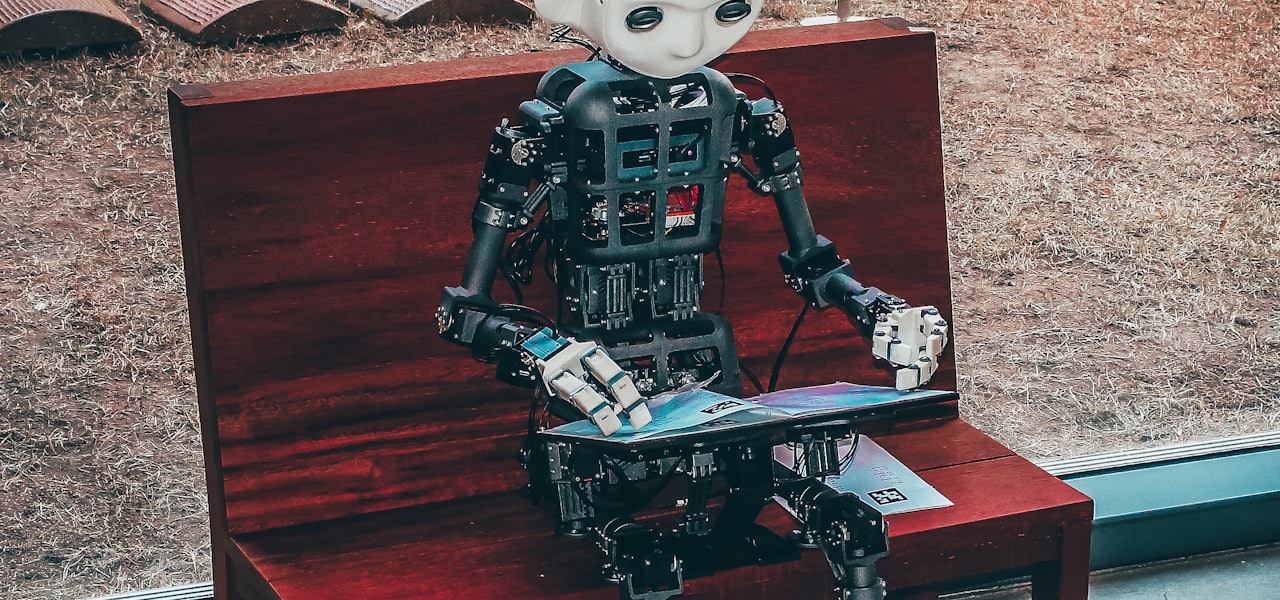
Comparing the best conversational AI platform? An conversational AI platform is software that uses machine learning to help you get more done — it lowers the barrier so anyone can produce professional output. Privacy matters too: check whether your data trains the model and whether a no-log or enterprise tier is available. Whether you are a beginner or a pro, the right conversational AI platform slots into your workflow and pays for itself fast. Below we compare features, pricing, and real output so you can choose with confidence.
Software agent
In computer science, a software agent is a computer program that acts for a user or another program in a relationship of agency. The term agent is derived from the Latin agere (to do): an agreement to act on one's behalf. Such "action on behalf of" implies the authority to decide which, if any, action is appropriate. Some agents are colloquially known as bots, from robot. They may be embodied, as when execution is paired with a robot body, or as software such as a chatbot executing on a computer, such as a mobile device, e.g. Siri. Software agents may be autonomous or work together with other agents or people. Software agents interacting with people (e.g. chatbots, human-robot interaction environments) may possess human-like qualities such as natural language understanding and speech, personality or embody humanoid form (see Asimo). Related and derived concepts include intelligent agents (in particular exhibiting some aspects of artificial intelligence, such as reasoning), autonomous agents (capable of modifying the methods of achieving their objectives), distributed agents (being executed on physically distinct computers), multi-agent systems (distributed agents that work together to achieve an objective that could not be accomplished by a single agent acting alone), and mobile agents (agents that can relocate their execution onto different processors). == Concepts == The basic attributes of an autonomous software agent are that agents: are not strictly invoked for a task, but activate themselves, may reside in wait status on a host, perceiving context, may get to run status on a host upon starting conditions, do not require interaction of user, may invoke other tasks including communication. The concept of an agent provides a method of describing a complex software entity that is capable of acting with a certain degree of autonomy in order to accomplish tasks on behalf of its host. But unlike objects, which are defined in terms of methods and attributes, an agent is defined in terms of its behavior. Various authors have proposed different definitions of agents, these commonly include concepts such as: persistence: code is not executed on demand but runs continuously and decides for itself when it should perform some activity; autonomy: agents have capabilities of task selection, prioritization, goal-directed behavior, decision-making without human intervention; social ability: agents are able to engage other components through some sort of communication and coordination, they may collaborate on a task; reactivity: agents perceive the context in which they operate and react to it appropriately. === Distinguishing agents from programs === All agents are programs, but not all programs are agents. Contrasting the term with related concepts may help clarify its meaning. Franklin & Graesser (1997) discuss four key notions that distinguish agents from arbitrary programs: reaction to the environment, autonomy, goal-orientation and persistence. === Intuitive distinguishing agents from objects === Agents are more autonomous than objects. Agents have flexible behavior: reactive, proactive, social. Agents have at least one thread of control but may have more. === Distinguishing agents from expert systems === Expert systems are not coupled to their environment. Expert systems are not designed for reactive, proactive behavior. Expert systems do not consider social ability. === Distinguishing intelligent software agents from intelligent agents in AI === Intelligent agents (also known as rational agents) are not just computer programs: they may also be machines, human beings, communities of human beings (such as firms) or anything that is capable of goal-directed behavior. == Impact of software agents == Software agents may offer various benefits to their end users by automating complex or repetitive tasks. However, there are organizational and cultural impacts of this technology that need to be considered prior to implementing software agents. === Organizational impact === === Work contentment and job satisfaction impact === People like to perform easy tasks providing the sensation of success unless the repetition of the simple tasking is affecting the overall output. In general implementing software agents to perform administrative requirements provides a substantial increase in work contentment, as administering their own work does never please the worker. The effort freed up serves for a higher degree of engagement in the substantial tasks of individual work. Hence, software agents may provide the basics to implement self-controlled work, relieved from hierarchical controls and interference. Such conditions may be secured by application of software agents for required formal support. === Cultural impact === The cultural effects of the implementation of software agents include trust affliction, skills erosion, privacy attrition and social detachment. Some users may not feel entirely comfortable fully delegating important tasks to software applications. Those who start relying solely on intelligent agents may lose important skills, for example, relating to information literacy. In order to act on a user's behalf, a software agent needs to have a complete understanding of a user's profile, including his/her personal preferences. This, in turn, may lead to unpredictable privacy issues. When users start relying on their software agents more, especially for communication activities, they may lose contact with other human users and look at the world with the eyes of their agents. These consequences are what agent researchers and users must consider when dealing with intelligent agent technologies. === History === The concept of an agent can be traced back to Hewitt's Actor Model (Hewitt, 1977) - "A self-contained, interactive and concurrently-executing object, possessing internal state and communication capability." To be more academic, software agent systems are a direct evolution of Multi-Agent Systems (MAS). MAS evolved from Distributed Artificial Intelligence (DAI), Distributed Problem Solving (DPS) and Parallel AI (PAI), thus inheriting all characteristics (good and bad) from DAI and AI. John Sculley's 1987 "Knowledge Navigator" video portrayed an image of a relationship between end-users and agents. Being an ideal first, this field experienced a series of unsuccessful top-down implementations, instead of a piece-by-piece, bottom-up approach. The range of agent types is now (from 1990) broad: WWW, search engines, etc. == Examples of intelligent software agents == === Buyer agents (shopping bots) === Buyer agents travel around a network (e.g. the internet) retrieving information about goods and services. These agents, also known as 'shopping bots', work very efficiently for commodity products such as CDs, books, electronic components, and other one-size-fits-all products. Buyer agents are typically optimized to allow for digital payment services used in e-commerce and traditional businesses. === User agents (personal agents) === User agents, or personal agents, are intelligent agents that take action on your behalf. In this category belong those intelligent agents that already perform, or will shortly perform, the following tasks: Check your e-mail, sort it according to the user's order of preference, and alert you when important emails arrive. Play computer games as your opponent or patrol game areas for you. Assemble customized news reports for you. There are several versions of these, including CNN. Find information for you on the subject of your choice. Fill out forms on the Web automatically for you, storing your information for future reference Scan Web pages looking for and highlighting text that constitutes the "important" part of the information there Discuss topics with you ranging from your deepest fears to sports Facilitate with online job search duties by scanning known job boards and sending the resume to opportunities who meet the desired criteria Profile synchronization across heterogeneous social networks === Monitoring-and-surveillance (predictive) agents === Monitoring and surveillance agents are used to observe and report on equipment, usually computer systems. The agents may keep track of company inventory levels, observe competitors' prices and relay them back to the company, watch stock manipulation by insider trading and rumors, etc. For example, NASA's Jet Propulsion Laboratory has an agent that monitors inventory, planning, schedules equipment orders to keep costs down, and manages food storage facilities. These agents usually monitor complex computer networks that can keep track of the configuration of each computer connected to the network. A special case of monitoring-and-surveillance agents are organizations of agents used to automate decision-making process during tactical operations. The agents monitor the status of assets (ammunition, weapons available, platforms for transport, etc.) and receive goals from hi
List & Label
List & Label is a professional reporting tool for software developers. It provides comprehensive design, print and export functions. The software component runs on Microsoft Windows and can be implemented in desktop, cloud and web applications. List & Label can be used to create user-defined dashboards, lists, invoices, forms and labels. It supports many development environments, frameworks and programming languages such as Microsoft Visual Studio, Embarcadero RAD Studio, .NET Framework, .NET Core, ASP.NET, C++, Delphi, Java, C Sharp and some more. List & Label either retrieves data from various sources via data binding, or works database independent. Reports are designed and created in the so-called List & Label Designer and then exported into a multitude of formats like PDF, Excel, XHTML and RTF. Since version 27 a web report designer for ASP.NET MVC is available. == History == The product was first released in 1992 by combit. The current version is 30. A new major version of List & Label is released every fall, usually in October. Updates are available several times a year via Service Pack. == Features == === Report Designer === The Designer enables users to graphically layout the report. It offers report objects such as tables, charts, crosstabs, gauges, HTML, conditionally formatted text, barcodes, matrix codes, and graphics, and is extensible using third-party add-ons. User applications can interact with the report via the programmable object model of the report. The real-time preview functionality allows users to view changes instantly. Usability features include layer and appearance management, enabling conditional logic to dynamically control the visibility of objects in reports. The Designer also supports the inclusion of multiple report containers in a single project, accommodating complex layouts such as parallel tables and charts. A formula wizard and support for scripting languages such as C# facilitate advanced calculations and logic. The Designer's object model (DOM) provides developers with the ability to modify layouts and behaviors programmatically. === Web Report Designer === The web report designer works browser-based and independent from printer drivers and spoolers - that makes deployments to the cloud easier. Just like the use of the Visual Studio deployment pipeline. === Data Sources === Depending on the programming language, the product offers automatic support for data sources: Databases such as Microsoft SQL Server, Oracle, MySQL, PostgreSQL, IBM Db2, SQLite, MariaDB, MongoDB, Cosmos DB XML data, CSV Business objects Data sources that can be accessed via OLE DB, ODBC or ADO.NET LINQ data and data from web services GraphQL Additionally, the product offers support for unbound data and can be extended to support other data sources via interfaces. === Output Options === Printer Image Formats (JPEG, BMP, EMF, TIFF, PNG, SVG, HEIF, WebP) Document Formats: PDF, PDF/A, Word (DOCX), Excel (XLS), PowerPoint (PPTX) HTML, XHTML, MHTML Barcodes Plain Text, RTF, CSV, JSON XML, ZIP, Email, JSON List & Label preview file === Target Audience === List & Label can be used in Windows development environments. While it competes most notably on the Microsoft .NET platform with other products such as Crystal Reports, SQL Server Reporting Services, ActiveReports, there are few competing products for other programming languages (e.g. Progress, Alaska Xbase++, Visual DataFlex). == Awards == Reader's Choice Award 2005–2008 Stevie Awards 2021: Best Technology for Data Visualization Top 100 Publisher Award Component Source 2013-2014, 2014-2015,2016, 2018, 2019, 2020, 2021, 2022
YNAB
You Need a Budget (YNAB) (pronounced ) is an online personal budgeting program based on the envelope system developed by a privately owned American company of the same name. It is available via any web browser or a mobile app. == History == The program was initially developed as standalone software in 2004 by Jesse Mecham, while he was in college pursuing his master's degree in accounting, after he and his wife faced financial difficulty and decided to improve their budgeting. It evolved from a spreadsheet that he created for the budgeting process. The acronym stands for "you need a budget." In 2015 they changed their licensing model to software as a service. In 2020, YNAB had 115 employees, all working remotely. == Overview == The service encourages users to follow four principles or "rules": Give every dollar a job: Each dollar in a budget is allocated to a specific purpose. This concept is also called zero-based budgeting. Embrace true expenses: All expenses are planned for, so that there are no surprises. Roll with the punches: Being flexible when there is overspending. Age your money: Keeping money in your budget without immediately spending it. Users can either import transactions automatically from their financial institutions or input them manually. The software also displays financial reports to keep users informed about their finances at a glance. == Awards and recognition == YNAB has been named one of the best budgeting apps by U.S. News & World Report, Kiplinger's Personal Finance, CNN, HuffPost, CNBC, and hundreds of other financial reporting outlets. The Wall Street Journal – Best budgeting app for hands-on budgeters. Forbes – Best Budgeting Apps Money – Best budgeting app for college students. Lifehacker – Most popular personal finance software. Wirecutter – "Great pick for hard-core budgeters". Investopedia – Best overall budgeting app.
Read the Docs
Read the Docs is an open-sourced free software documentation hosting platform. It generates documentation written with the Sphinx documentation generator, MkDocs, or Jupyter Book. == History == The site was created in 2010 by Eric Holscher, Bobby Grace, and Charles Leifer. On March 9, 2011, the Python Software Foundation Board awarded a grant of US$840 to the Read the Docs project for one year of hosting fees. On November 13, 2017, the Linux Mint project announced that they were moving their documentation to Read the Docs. In 2020, Read the Docs received a $200,000 grant from the Chan Zuckerberg Initiative. For 2021, Read the Docs reported 700 million page views and 196 million unique visitors. In 2013, a "Write the Docs" conference for Read the Docs users was launched, which has since turned into a generic software-documentation community. As of 2024, it continues to hold annual global conferences, organize local meetups, and maintain a Slack channel for "people who care about documentation."
Smart object
A smart object is an object that enhances the interaction with not only people but also with other smart objects. Also known as smart connected products or smart connected things (SCoT), they are products, assets and other things embedded with processors, sensors, software and connectivity that allow data to be exchanged between the product and its environment, manufacturer, operator/user, and other products and systems. Connectivity also enables some capabilities of the product to exist outside the physical device, in what is known as the product cloud. The data collected from these products can be then analysed to inform decision-making, enable operational efficiencies and continuously improve the performance of the product. It can not only refer to interaction with physical world objects but also to interaction with virtual (computing environment) objects. A smart physical object may be created either as an artifact or manufactured product or by embedding electronic tags such as RFID tags or sensors into non-smart physical objects. Smart virtual objects are created as software objects that are intrinsic when creating and operating a virtual or cyber world simulation or game. The concept of a smart object has several origins and uses, see History. There are also several overlapping terms, see also smart device, tangible object or tangible user interface and Thing as in the Internet of things. == History == In the early 1990s, Mark Weiser, from whom the term ubiquitous computing originated, referred to a vision "When almost every object either contains a computer or can have a tab attached to it, obtaining information will be trivial", Although Weiser did not specifically refer to an object as being smart, his early work did imply that smart physical objects are smart in the sense that they act as digital information sources. Hiroshi Ishii and Brygg Ullmer refer to tangible objects in terms of tangibles bits or tangible user interfaces that enable users to "grasp & manipulate" bits in the center of users' attention by coupling the bits with everyday physical objects and architectural surfaces. The smart object concept was introduced by Marcelo Kallman and Daniel Thalmann as an object that can describe its own possible interactions. The main focus here is to model interactions of smart virtual objects with virtual humans, agents, in virtual worlds. The opposite approach to smart objects is 'plain' objects that do not provide this information. The additional information provided by this concept enables far more general interaction schemes, and can greatly simplify the planner of an artificial intelligence agent. In contrast to smart virtual objects used in virtual worlds, Lev Manovich focuses on physical space filled with electronic and visual information. Here, "smart objects" are described as "objects connected to the Net; objects that can sense their users and display smart behaviour". More recently in the early 2010s, smart objects are being proposed as a key enabler for the vision of the Internet of things. The combination of the Internet and emerging technologies such as near field communications, real-time localization, and embedded sensors enables everyday objects to be transformed into smart objects that can understand and react to their environment. Such objects are building blocks for the Internet of things and enable novel computing applications. In 2018, one of the world's first smart houses was built in Klaukkala, Finland in the form of a five-floor apartment block, using the Kone Residential Flow solution created by KONE, allowing even a smartphone to act as a home key. == Characteristics == Although we can view interaction with physical smart object in the physical world as distinct from interaction with virtual smart objects in a virtual simulated world, these can be related. Poslad considers the progression of: how humans use models of smart objects situated in the physical world to enhance human to physical world interaction; versus how smart physical objects situated in the physical world can model human interaction in order to lessen the need for human to physical world interaction; versus how virtual smart objects by modelling both physical world objects and modelling humans as objects and their subsequent interactions can form a predominantly smart virtual object environment. === Smart physical objects === The concept smart for a smart physical object simply means that it is active, digital, networked, can operate to some extent autonomously, is reconfigurable and has local control of the resources it needs such as energy, data storage, etc. Note, a smart object does not necessarily need to be intelligent as in exhibiting a strong essence of artificial intelligence—although it can be designed to also be intelligent. Physical world smart objects can be described in terms of three properties: Awareness: is a smart object's ability to understand (that is, sense, interpret, and react to) events and human activities occurring in the physical world. Representation: refers to a smart object's application and programming model—in particular, programming abstractions. Interaction: denotes the object's ability to converse with the user in terms of input, output, control, and feedback. Based upon these properties, these have been classified into three types: Activity-Aware Smart Objects: Are objects that can record information about work activities and its own use. Policy-Aware Smart Objects: Are objects that are activity-aware Objects can interpret events and activities with respect to predefined organizational policies. Process-Aware Smart Objects: Processes play a fundamental role in industrial work management and operation. A process is a collection of related activities or tasks that are ordered according to their position in time and space. === Smart virtual objects === For the virtual object in a virtual world case, an object is called smart when it has the ability to describe its possible interactions. This focuses on constructing a virtual world using only virtual objects that contain their own interaction information. There are four basic elements to constructing such a smart virtual object framework. Object properties: physical properties and a text description Interaction information: position of handles, buttons, grips, and the like Object behavior: different behaviors based on state variables Agent behaviors: description of the behavior an agent should follow when using the object Some versions of smart objects also include animation information in the object information, but this is not considered to be an efficient approach, since this can make objects inappropriately oversized. === Categorization === The terms smart, connected product or smart product can be confusing as it is used to cover a broad range of different products, ranging from smart home appliances (e.g., smart bathroom scales or smart light bulbs) to smart cars (e.g., Tesla). While these products share certain similarities, they often differ substantially in their capabilities. Raff et al. developed a conceptual framework that distinguishes different smart products based on their capabilities, which features 4 types of smart product archetypes (in ascending order of "smartness"). Digital Connected Responsive Intelligent == Advantages == Smart, connected products have three primary components: Physical – made up of the product's mechanical and electrical parts. Smart – made up of sensors, microprocessors, data storage, controls, software, and an embedded operating system with enhanced user interface. Connectivity – made up of ports, antennae, and protocols enabling wired/wireless connections that serve two purposes, it allows data to be exchanged with the product and enables some functions of the product to exist outside the physical device. Each component expands the capabilities of one another resulting in "a virtuous cycle of value improvement". First, the smart components of a product amplify the value and capabilities of the physical components. Then, connectivity amplifies the value and capabilities of the smart components. These improvements include: Monitoring of the product's conditions, its external environment, and its operations and usage. Control of various product functions to better respond to changes in its environment, as well as to personalize the user experience. Optimization of the product's overall operations based on actual performance data, and reduction of downtimes through predictive maintenance and remote service. Autonomous product operation, including learning from their environment, adapting to users' preferences and self-diagnosing and service. === The Internet of things (IoT) === The Internet of things is the network of physical objects that contain embedded technology to communicate and sense or interact with their internal states or the external environment. The phrase "Internet of things" reflects the gro
Box blur
A box blur (also known as a box linear filter) is a spatial domain linear filter in which each pixel in the resulting image has a value equal to the average value of its neighboring pixels in the input image. It is a form of low-pass ("blurring") filter. A 3 by 3 box blur ("radius 1") can be written as matrix 1 9 [ 1 1 1 1 1 1 1 1 1 ] . {\displaystyle {\frac {1}{9}}{\begin{bmatrix}1&1&1\\1&1&1\\1&1&1\end{bmatrix}}.} Due to its property of using equal weights, it can be implemented using a much simpler accumulation algorithm, which is significantly faster than using a sliding-window algorithm. Box blurs are frequently used to approximate a Gaussian blur. By the central limit theorem, repeated application of a box blur will approximate a Gaussian blur. In the frequency domain, a box blur has zeros and negative components. That is, a sine wave with a period equal to the size of the box will be blurred away entirely, and wavelengths shorter than the size of the box may be phase-reversed, as seen when two bokeh circles touch to form a bright spot where there would be a dark spot between two bright spots in the original image. == Extensions == Gwosdek, et al. has extended Box blur to take a fractional radius: the edges of the 1-D filter are expanded with a fraction. It makes slightly better gaussian approximation possible due to the elimination of integer-rounding error. Mario Klingemann has a "stack blur" that tries to better emulate gaussian's look in one pass by stacking weights: 1 9 [ 1 2 3 2 1 ] {\displaystyle {\frac {1}{9}}{\begin{bmatrix}1&2&3&2&1\end{bmatrix}}} The triangular impulse response it forms decomposes to two rounds of box blur. Stacked Integral Image by Bhatia et al. takes the weighted average of a few box blurs to fit the gaussian response curve. == Implementation == The following pseudocode implements a 3x3 box blur. The example does not handle the edges of the image, which would not fit inside the kernel, so that these areas remain unblurred. In practice, the issue is better handled by: Introducing an alpha channel to represent the absence of colors; Extending the boundary by filling in values, ranked by quality: Fill in a mirrored image at the border Fill in a constant color extending from the last pixel Pad in a fixed color A number of optimizations can be applied when implementing the box blur of a radius r and N pixels: The box blur is a separable filter, so that only two 1D passes of averaging 2 r + 1 pixels will be needed, one horizontal and one vertical, for each pixel. This lowers the complexity from O(Nr2) to O(Nr). In digital signal processing terminology, each pass is a moving-average filter. Accumulation. Instead of discarding the sum for each pixel, the algorithm re-uses the previous sum, and updates it by subtracting away the old pixel and adding the new pixel in the blurring range. A summed-area table can be used similarly. This lowers the complexity from O(Nr) to O(N). When being used in multiple passes to approximate a Gaussian blur, the cascaded integrator–comb filter construction allows for doing the equivalent operation in a single pass.